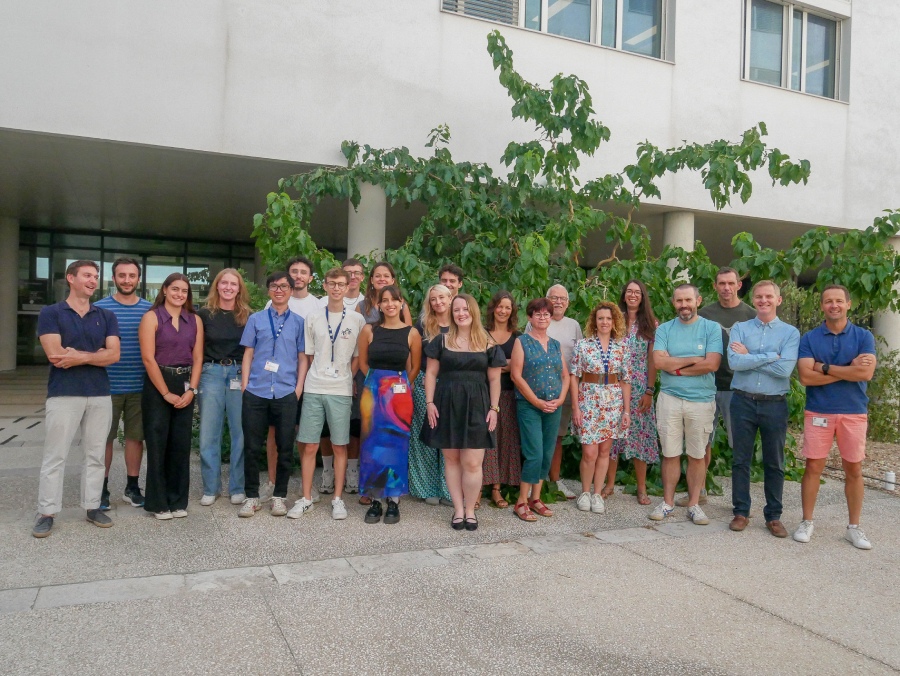
The Department of Polymers for Health and Biomaterials (PHBM) at IBMM (UM, CNRS UMR 5247, ENSCM) is a multidisciplinary research group dedicated to polymers related to biomedical applications. The PHBM, originally known as the Department of Artificial Biopolymers (CRBA), was founded in the 1980s and has since pursued its main objectives of designing, synthesizing, characterizing and evaluating polymers to meet the requirements of therapeutic applications. The PHBM is recognized for its expertise in degradable polymers and polymer biomaterials for healthcare applications. The PHBM brings together expertise in polymers, macromolecular chemistry and biomedical sciences. It is currently headed by Prof. Xavier Garric.
The main topics developed at PHBM are advanced polymer biomaterials, polymers for tissue engineering and medical devices, polymers for drug delivery and methodological development of polymer characterization techniques. More details on our activities can be found on the research and publications pages.
In addition to fundamental research, the PHBM is heavily involved in value-adding and transfer activities through collaborations with clinicians and industrial partners, as well as through the creation of spin-offs, and is a member of the Institut Carnot Chimie Balard Cirimat.
The PHBM’s integrated, multidisciplinary research environment offers excellent opportunities for finding practical solutions to unmet clinical needs.
Our Themes
Advanced polymer biomaterials
The objective of this exploratory theme is to synthesize polymers, hybrid polymers, and polymer composites with unique properties to meet the requirements of advanced biomedical applications. In this context, we are developing chemical strategies to create new degradable (co)polymers with multiple functionalities, introduce bioactivity (for example, on surfaces), or enhance the properties of existing biomaterials and composites (resorbable elastomers, stimulus-responsive biomaterials, self-healing materials, etc.). These innovative (co)polymers possess properties of interest that are leveraged in other application-oriented research of PHBM.
Medical devices and tissue engineering
Our aim is to design tailor made degradable (co)polymers that meet the specific requirements of temporary medical devices or scaffolds for tissue engineering. To achieve this, we combine our expertise in polymer synthesis with processing techniques such as 3D printing or electrospinning. Simple polymer matrices, porous biomaterials, fibrous biomaterials, and their combinations are primarily investigated. The introduction of biologically active biomaterials into these matrices is also being studied by the PHBM.
Active Ingredient Release Systems
The aim of this research is to provide polymer systems that address the challenges of active ingredient formulation: high loading rates, polymer/active ingredient interactions, reduced side effects, controlled release, co-formulation of actives molecules, stimuli-responsive release, vectorization, targeting, etc. Our research is driven by innovation while keeping regulatory aspects in mind. In this thematic area, we also develop new degradable (co)polymers for self-assemblies, including micelles, nanoparticles, microparticles, gels, and coatings for medical devices.
Methodological development and characterization of polymers
The team develops advanced methodologies for the physico-chemical characterization of degradable polymers and their in vivo monitoring. These analytical tools, coupled with the SynBio3 platform, allow to better understand the behavior of biomaterials within the organism and accelerate their development towards clinical applications.