

6 months intership : Role of the Ghrelin System in Weight Gain in Patients with Breast Cancer
Background
Unlike many other types of cancer, which are often associated with weight loss, patients with breast cancer may experience weight gain following diagnosis. This phenomenon, which remains poorly understood, represents an important public health issue. It is associated with an increased risk of mortality, both through the risk of cancer recurrence and through the development of comorbidities, such as cardiovascular disease and diabetes.
This project focuses on the potential role of the ghrelin system in cancer-associated weight gain. Ghrelin is a hormone involved in the regulation of hunger and energy metabolism. It acts primarily through its receptor, GHSR (Growth Hormone Secretagogue Receptor), which plays a key role in the regulation of food intake and energy balance.
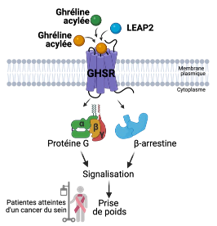
Ghrelin circulates mainly in two forms: acylated ghrelin, the active form that is essential for GHSR activation and stimulation of food intake, and desacylated ghrelin, which was long considered to be inactive but may have independent metabolic effects. GHSR activity is also modulated by LEAP2 (Liver-Expressed Antimicrobial Peptide 2), a liver-derived peptide that inhibits receptor activity.
Project Objective
In order to precisely characterize alterations in this system and overcome some of the limitations of conventional immunological methods, particularly the need for relatively large sample volumes and the difficulty in distinguishing between different forms of ghrelin, this project aims to develop a liquid chromatography-tandem mass spectrometry (LC-MS/MS) method for the simultaneous measurement of acylated ghrelin, desacylated ghrelin, and LEAP2 in very small plasma volumes.
The method developed will then be used to investigate alterations in the ghrelin system in patients with breast cancer, with or without weight gain.
Significance of the Project
This work forms part of a broader research effort aimed at better characterizing the role of the ghrelin-GHSR-LEAP2 axis in weight gain following breast cancer.
Finally, a better understanding of this pathway could help identify the mechanisms underlying the metabolic alterations observed in some patients and contribute to the development of new therapeutic strategies to prevent or limit breast cancer-associated weight gain, thereby improving patients’ prognosis and quality of life.
Research supervisors
Research lab
Cell Pharmacology
Institut des Biomolécules Max Mousseron (IBMM) UMR 5247 CNRS/ENSCM/Université Montpellier
1919, route de Mende
34293 Montpellier
France
Date
February–July 2027